Cutaneous fold crossing theory

A fold crossing is the place where two cutaneous folds meet.
You can find thousands of them all over your body.

Fold crossings start out as simple skin deformations, but they keep on growing and deepening all your life.
Fold crossings have several repercussions, but the two main ones are:
• Pain; the majority of your aches and pains originate from your fold crossings,
• Skin defects and disorders; visible aesthetic deteriorations.
| MAIN FOLD CROSSINGS ON THE FOREHEAD |
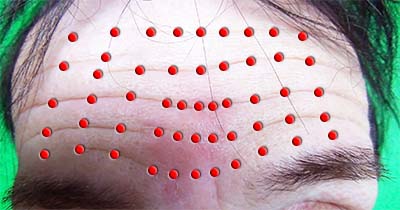 |
As a person ages, several extra folds (sometimes diagonal) will be added in between the ones pictured above.
On this page
Fold crossing evolution
Fold crossing creation
First, let’s separate the two folds of the crossing and call them; Fold A and Fold B.

Very early in your life, Fold A and Fold B began to meet when you performed a particular movement.
At first, they probably didn't intersect at exactly the same point every time.
With time, the path of each fold became imprinted into your skin, under the action of the skin's wound-healing process; superficial cicatrisation.
Then, the position of their meeting point became fixed. style="margin-bottom: 20px;"
| A FOLD CROSSING HAS FOUR CORNERS |
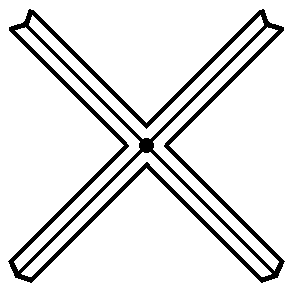 |
Once a crossing point is fixed in one location on your body, it becomes an anchor.
Any tension in the neighboring skin is relayed to the fold crossing.
Superficial cicatrisation locks the center
Fresh epidermis cells, triggered by the skin's wound healing process, superficial cicatrisation, will come to the rescue of the poor crossing in order to prevent breakage or puncture.
One by one, coats of protective epidermis cells solidify the crossing's center.
| EPIDERMIS LOCKS THE CENTER OF THE FOLD CROSSING |
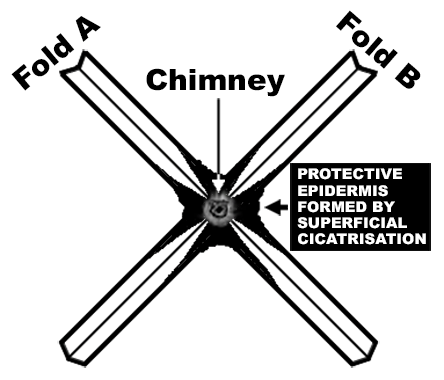 |
The newly added cells solidify the skin of the mistreated region, but they lock the crossing into place even more.
Most fold crossings are unobservable
Over 95% of your fold crossings cannot be seen, along with the folds that generate them.
Since the folds and crossings are already made of epidermis, and that they get filled with epidermis cells to protect the skin; they cannot be observed easily.
It's epidermis over epidermis.
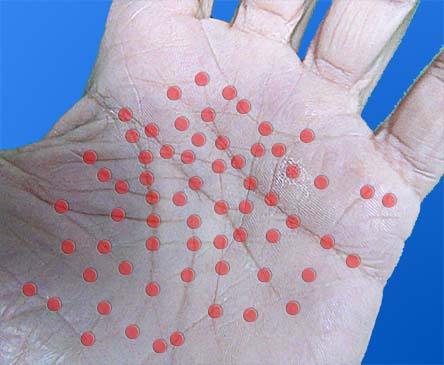
However, you can see many in some places, such as the palms of your hands and feet and your face.
Normally, only problematic fold crossings will catch your attention.
| MAIN FOLD CROSSINGS ON THE PALM OF THE HAND |
 |
Fold crossing patterns
The folds of a crossing often cross each other perpendicularly.
Since your most fundamental folds are vertical and horizontal, their intersections are straight.
But, your actions, positions and expressions distort the folds, and create all kinds of new local folds that are often diagonal.
So, the shape of the fold crossings you'll find on your body is of your own making, and you'll discover all kinds of configurations.


The fold crossing chimney
The center of the fold crossing forms a cavern
The four corners of the fold crossing almost completely encase its center.
But, there remains a void.
With time, this structure solidifies, developing into a tunnel made of skin.

The top of the fold crossing may well be covered with epidermal cells; there will nevertheless always remain a void, a cavity beneath.
Fold crossings grow inwards
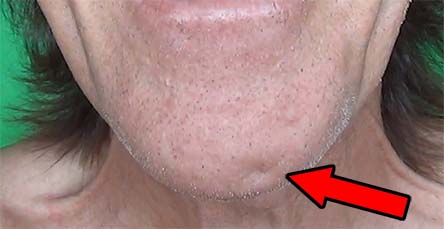
Since folds A and B are already grooves, not mounds, the fold crossing is a hole.

As they evolve and fixate, fold crossings grow deeper and deeper below the surface of your skin.
| Dimples are fold crossings |
 |
Folds growing inwards coat by coat
Each time epidermis formation paves the fold, it strengthens and hardens it.
Each new coat finds a new, evolved situation.
Conditions have changed slightly.
This results in a different epidermis structure for each new coat.
As the number of coats increases, unfolded skin at the top is pulled down, and the whole edifice deepens into the flesh.

Coats and grooming
When you groom a fold, it unfolds coat by coat.
Fold crossing chimneys pin the skin down
The tensions on the chimney, in the center of the fold crossing, keep on increasing with time.
The fold crossing deepens.
The bottom of the crossing becomes riveted to whatever is beneath it.

The tension and grip from the thousands of fold crossings on your body, on whatever lies beneath them, augments continuously.
The consequence is that your skin becomes tightly fastened to your body.
It's as if your skin was shrinking on you.

Outgrowths, skin conditions and disorders
The top opening of a fold crossing tunnel normally stays open.
When this is the case, the larger ones may be noticed as holes, cavities and oversized pores.
However, superficial cicatrisation often forms a cap that closes the top of the crossing.
When this happens, the outgrowth can keep on developing and become aesthetically displeasing.
But, the real problem comes from the entrapped bodily wastes that remain locked-up inside the tunnel.

| For more information on skin outgrowths |
The grid of folds
Your whole body is covered with a grid of folds

Your skin’s natural horizontal and vertical folding tendency ends up creating a grid of folds and crossings all over your body.

The grid; skin tensions and pain
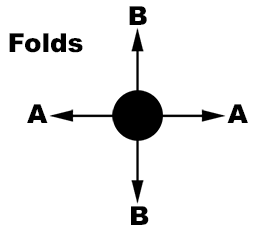
A fold crossing is always under tension.
It's like being in the center of a four-way tug-of-war.
Any movement you make pulls on the skin somewhere, and this tension is relayed to the neighboring fold crossings.
In many cases, the tension becomes so great that pain arises.

•In the center.
When you're inactive, the tension on your fold crossings may be equal on all four sides.
| Stable fold crossing |
 |
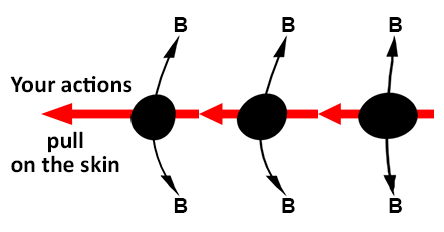
But, when you move, your actions pull on the skin and consequently on the folds and their crossings.
The nearest fold crossings are destabilized by the tug coming from one direction.
In some situations, pain may appear.
The tension on one crossing is relayed to all the crossings in its vicinity, but mostly to the adjoining crossings on the same fold.
| Destabilized fold crossings |
 |

The grid is problematic
The grid of fold crossings has several disadvantages;
• It greatly reduces the skin's flexibility and elasticity,
• It spreads the pain to adjoining regions,
• On the face, expressiveness and beauty are diminished,
• It interconnects problem areas,
• Doing one movement now affects regions further and further away,
• ...
The grid is tightening
Because the size of your body has increased since your youth; the grid has tightened continuously.
It is deepening into your flesh.
It's as if you were still wearing the clothes you wore in your youth.
With time, the folds and crossings multiply, enlarge and squeeze your skin still more.
This reduces your capacity to move, and makes anything you do more painful as you get older.