Human hair; from folds in the scalp to baldness
Are you wondering what's wrong with your hair?
But, you've never even touched your scalp with your nails?
Well, do it right now!
Press your nails into your scalp, and you'll understand that the hardened skin makes normal hair growth impossible.
However, if you move your nails over the surface, you'll discover all kinds of ridges, bumps, and holes.
Those are cutaneous folds and their crossings.
They are responsible for the hardening of the skin.
So cheer up, because cutaneous folds can be unfolded using human grooming techniques.
On this page
The main cutaneous folds on the scalp
Main folds on the top of the scalp
Front top view
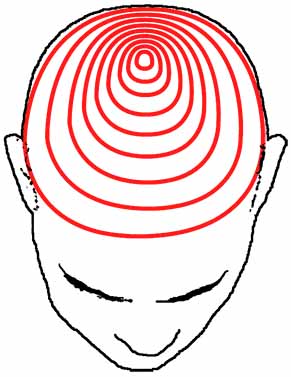
Horizontal folds circle your fingers, knees, waist, neck and all your articulations.
They form this concentric pattern on the top of your head.
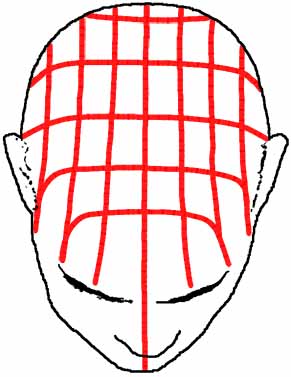
The top of your scalp is one of the most folded areas on your body.
Two main reasons explain this:
● A crust, made of dead skin cells and sebum, has formed.
● Cutaneous folds in your scalp create an unusual pattern as they reach the top of your head.
The folds form lines and circles, and their intersections anchor the skin deeply to the skull.
The skin becomes so tough that it can no longer be pinched or pulled, as it can be elsewhere on the body.
This is why it is no longer called "skin", but rather "leather" or "scalp".
Main folds on the back of the scalp
Back view
HORIZONTAL FOLDS |
VERTICAL FOLDS |
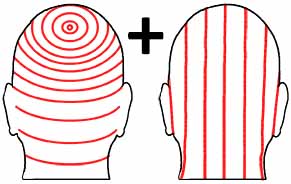

The skin on the back of your head is much less folded than it is on top.
The folds follow the same vertical-horizontal pattern found on most of your body.
This explains why hair loss is less frequent or severe at the back of the head.
How to rejuvenate your scalp with grooming techniques
Grooming your scalp to restore its growability
The skin on your head is too hard and encrusted for hair to grow there.
You want to use your nails to restore your scalp's flexibility.
You will need to use two distinct grooming techniques to accomplish this task:
●1 Pressure grooming; Repeatedly pressing your nails into your scalp will soften it, and restore its elasticity.
●2 Superficial grooming; Gently raking your scalp with your nails will remove the thick sebum/skin crust covering it.
Your nails won't damage your hair follicles
Your fear of uprooting your hair with your nails is normal.
But, your hair follicles are conceived to be bent and tilted by your nails.
By bending the base of a hair shaft, you create a pressure on the sebaceous glands, forcing them to expel some sebum.
Sebum is a natural lubricant that allows you to groom the skin without harming it.
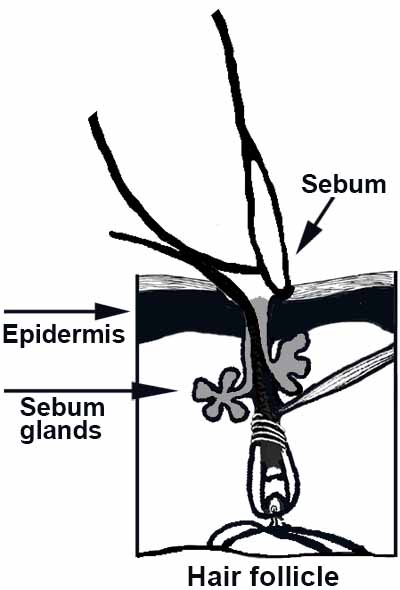
For more information; see "The hair follicle" below.
And, for even more information on the subject; see the "Why do you have sebum glands?" page.
Using both hands, and four fingers
Your scalp is an easy surface to groom because it's flat, with no feature to obstruct your actions.
It's also a large area to cover.
This makes it an ideal place to use:
● Four-finger techniques; where you line-up your four nails together,
● Two-handed techniques; where you work simultaneously on both sides of the head.
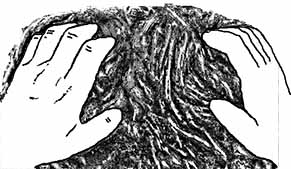
●1- Pressure grooming
Peck your scalp with pressure strokes
Pressure grooming strokes are extremely easy to perform.
You simply press your nails firmly into your scalp.
By doing so, you break up the hardened crust on your scalp, and your skin will gradually regain its suppleness.
However, you will need to repeat these movements thousands and thousands of times.
How to pressure groom your scalp
●1- Align your nails on both hands,
●2- Place your hands on your scalp at symmetrical positions,
●3- Press your nails into your scalp forcefully for one second,
●4- Change your position a bit, and repeat.
- Important -
Don't move once the pressure is applied.

Understanding the process
Compare the hardness of your scalp to that of your normal skin, elsewhere on your body.
You'll be amazed and disturbed by how little your nails can penetrate your scalp.
The skin on the top of your head is as hard as wood.
That's why hair struggles to grow there.
Repeatedly pecking your scalp with pressure strokes will slowly soften the skin.
It's a bit like reviving a piece of dried-out modeling clay or putty by kneading and squeezing it.
Precautions
Peck your scalp this way, for only a few minutes, several times a day.
But, don't overdo it.
Once you've pressed your nails deeply into the skin; don't move, or you'll injure the skin.
If you hurt yourself in any way; stop grooming the area for a while.

Spend more time working on places where you feel some hardened lines, like those illustrated in the maps above.
Put more effort in the areas that are starting to thin, or already bald.
With time, you will feel the skin's hardness reduce, and its elasticity increase.
For more information: Pressure grooming.
●2- Superficial grooming
Remove the top epidermis coats with superficial strokes
Your scalp is covered with a thick crust.
The large sebum production, coming from each hair follicle's sebaceous glands, has prevented the normal exfoliation of dead skin cells from the top of your scalp.
A thick coat, composed mostly of a mixture of dead epidermis cells and hardened sebum, has formed.
You can remove these cells by raking your scalp with your nails, but you can only apply light pressure, or you'll hurt yourself.
How to superficially groom your scalp
●1- Align your nails on both hands,
●2- Place your nails on your scalp at symmetrical positions,
●3- Press your nails lightly into your scalp,
●4- Move your hands around the whole surface.
- Important -
Only apply a light pressure.
Precautions
Don't apply too much pressure when you move your hands, or you may not only hurt yourself, you may uproot your remaining hair follicles.
If performed with light pressure, this technique will free your scalp, but it will also reset and reposition your hair follicles.
Superficially grooming your scalp provokes a pleasant sensation, and you can feel that your hair follicles love the treatment.
For more information: Superficial grooming.
Mapping your head
If you take the time to locate the cutaneous folds that criss-cross your head, you'll be able to groom them specifically.
Here's what you're looking for when you run your nails over your scalp:
● Folds; they feel like lines of insensitive, hardened skin.
● Lumps and holes; these deformations are fold crossings.
Make a mental map of these hardened places and abnormal features.
It will help you understand your problem, and guide you on where you need to work the most.
Grooming your scalp under the shower
When you wash your hair, your movements are very similar to grooming.
All you have to do is to press your nails a bit deeper into your scalp.
You want to increase the pressure without restricting the movements of your hands.
Both the soap and the water have an epidermis-removing action, and make the skin more malleable.
Don't miss the opportunity, groom your scalp every time you shampoo.
Get informed about human grooming
Human grooming lets you use your nails to unfold your skin, and remove dead cells on your whole body.
The following video will get you started:

|
Human grooming rediscovered - Video |
Is your scalp an infertile place to grow?
Cutaneous folds on the scalp and hair loss
Is the skin at the top of your head so hard that nothing could grow there?
Does the skin feel compacted to the touch, and stiffer than anywhere else on your body?
If you do nothing, the situation will continue to worsen.

Like the earth of a neglected garden, the skin of your scalp needs to be worked if you want something to grow there.
You'll have to remove the hardness, to restore the skin's elasticity.

You don't need to buy expensive equipment to do this job.
You are naturally equipped with the best tools for this task.
Your fingernails.
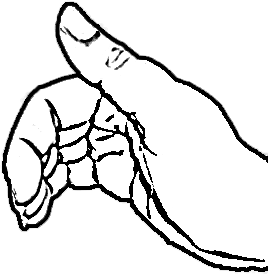
Alopecia, hair loss, and baldness
Science tells us that we lose hair follicles with age.
Where do they go?
Do they vanish?
No, they become engulfed in cutaneous folds.
Trapped between two sheets of skin.
Your hair is strangled and compressed by the skin tension that has developed in your scalp.
When the follicles are imprisoned in this way, they slow down their hair production.
Slowly, hair density decreases.
Then, the hair stops growing altogether.
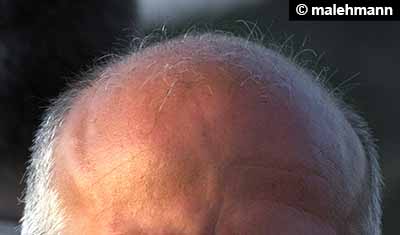
Not genetic, hereditary, or hormonal
Hair loss is not an illness or a disease.
It's a lack of care.
The condition of your ancestors' hair cannot influence yours.
Similarities in skull shape and lifestyles explain the similarities in balding patterns.
You can reverse the trend by grooming your scalp.
Dandruff
Without regular grooming with your nails, the dead skin cells produced by your scalp remain in place.
They dry out, and some flake off as dandruff.
Grooming removes the dandruff in the most natural manner.
The process thins out the dead-cell/sebum crust that hinders the normal exfoliation process on your scalp.
The hair follicle
Hair is produced by the skin.
It is made of compacted skin cells, just like nails.
Hair follicles are the factories that produce these compressed filaments.
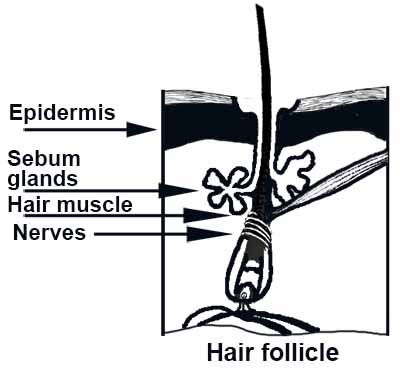
Hair follicles are embedded deep within your skin, about three-sixteenths of an inch, and generate keratin and a little melanin.
They do this at possibly the fastest multiplication rate of the human body.
Keratin is a hard protein.
Nails, claws, feathers, hooves, and horns are also made out of it.
The melanin adds the color component.
Hair, unlike plants, grows from the base.
Once it emerges from its follicle, it is dead.
How sebum is released
Each hair follicle has one or more sebum glands attached to it.
Sebum is a natural oil specifically designed for your skin and hair.
As your grooming nail bristles the base of the hair, it creates pressure on the gland, causing it to release some sebum.
This is a truly ingenious and superbly well-designed system.
It allows sebum to be expelled precisely where and when it is needed as a lubricant for grooming.
Humans have more hair follicles than chimpanzees
Even though chimpanzees and gorillas appear hairier, it's humans who win in this category.
Humans have more hair follicles per square inch of skin than chimpanzees do.
Our body hair has shrunk and faded on many parts of the body, except for the top of the head and a few other areas.
Despite this, the hair follicles, the structures that produce the hair, are all intact in the skin.
Your palms, soles, lips, eyelids, penis, labia minora and nipples are the only hairless parts on your body.
Furthermore, the quantity of hair, and its body distribution, are similar for all populations of our species.
When you look closely at anybody's skin, mostly in the sun, you will see hair all over the place.
Hair follicles are extremely resistant.
Almost all baby primates cling to their mother's fur to move around.

Conclusions
Alopecia affects mostly male humans.
Hair plays such a significant role in one's self-esteem, that I believe it will be one of the main motivations driving men to groom themselves.
Men are affected quite young by their lack of grooming with acne, hair loss and uglying.
Once you groom your scalp, the habit easily shifts to the rest of the body.
However, I must warn you against the idea of grooming only your scalp without considering your face.
All the tension released from the top of your head would transfer to the bottom; making you uglier.
So, I think that only a whole-head approach will do.